


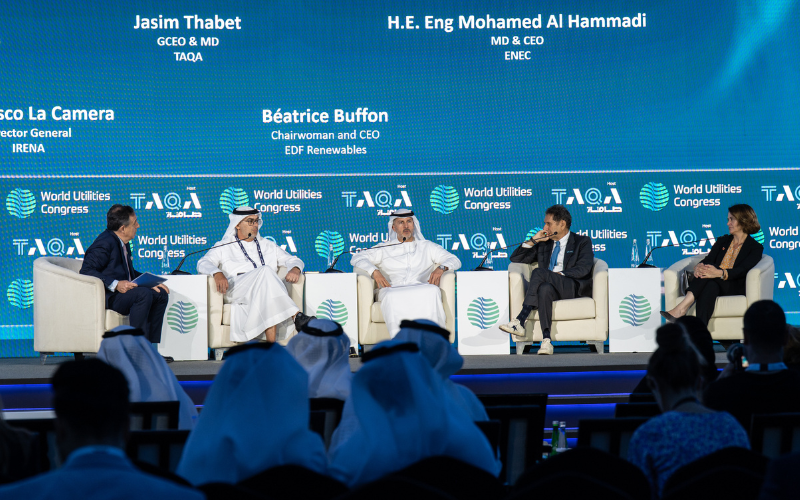
Jasim Thabet
Group CEO & MD
TAQA

Delivering a just and equitable energy transition requires a fundamental redesign of the global energy system. As geopolitical tensions rise and supply chains become more contested, energy security has re-emerged as a central driver of policy and investment. Governments and industry are prioritising resilience, diversification, and greater regional capacity, while utilities sit at the center of this shift—balancing long-term system stability with the urgent need to decarbonise.
Electricity demand is accelerating as economies expand, industries electrify and digital infrastructure scales. Meeting this demand will require coordinated investment across generation, grids and enabling technologies. As renewables and AI-driven data centers grow, networks must become more intelligent, flexible, and responsive—integrating distributed energy resources while maintaining reliability and affordability.
Pressure on water systems is intensifying in parallel. With global population and economic output set to rise significantly by 2050, water security is becoming an increasingly critical constraint—particularly in emerging and water-stressed regions. In the Middle East, many cities depend heavily on desalination, in some cases for up to 90% of supply. While this has enabled rapid development, it also creates systemic vulnerability, with entire populations reliant on uninterrupted infrastructure.
Under the theme “Empowering Tomorrow’s Utilities Today,” the Strategic Conference at the World Utilities Congress 2026 convenes global leaders and decision-makers to address these interconnected challenges. With a focus on reducing risk, strengthening cooperation, and accelerating deployment, the conference aligns policy, investment, and innovation to deliver resilient, reliable, and sustainable power and water systems at scale.
SDG7 aims for affordable, reliable energy for all by 2030. While 92% of people have basic electricity access, 750 million do not. Strong policies and coordinated action across governments, regulators, utilities, and innovators are essential to drive investment, reduce inequalities, and close the energy access gap. Market design, regulatory frameworks, and targeted subsidies balance affordability with financial stability.
Global energy investment in 2025 is likely to have passed USD3.3 trillion, with USD 2.2 trillion going to clean energy technologies. Solar will attract the largest share, USD 450 billion. However, grid investment is lagging, threatening energy security. Many utilities lack the capital to invest in aging infrastructure. To address this, they are exploring alternative financing models. If not addressed, utilities and communities will struggle to upgrade the vital systems they depend on.
As the world shifts to cleaner energy, utilities must strengthen resilience. In the Middle East, fast-growing demand makes this essential. Efficiency, flexibility, and smart grids help reduce peak loads, ensure reliability, and balance supply and demand. With smart meters and digital services, empowered customers further enhance stability and support a future-ready energy system.
Renewable energy systems depend on innovation. Digital transformation enhances grid efficiency, increases the integration of renewables, and manages demand effectively. Progress in hard technologies, such as solar, wind, and energy storage, is crucial. Additionally, sensors, AI, and analytics are revolutionising energy production. Unlocking the full potential of digitally enabled “new infrastructure” requires coordinated action across the value chain, supported by strategic investment, clear policy direction, and strong cross-sector collaboration.
Compute power is critical as AI grows. By 2030, data centres need $7 trillion, raising electricity use from 1% to 3%. Utilities must upgrade grids and manage heat. While AI can cut energy intensity, rising water demand requires coordinated policy, finance, technology, and market actions to ensure sustainable AI development.
Policy certainty underpins the energy transition. Stable, transparent, and predictable policies enable investment, efficient utility planning, and lower costs for customers. Governments that balance ambition and consistency, providing clarity in regulation and long-term planning, can build trust, attract sustained investment, and accelerate global progress toward net zero.
Group CEO & MD
TAQA
Director General
Federal Authority for Nuclear Regulation
Chairman & CEO
EDF
Group CEO & Vice Chairman
BEEAH Group
President & CEO
Mitsubishi Power EMEA
Chairwoman & CEO of EDF Power solutions, VP of EDF Group
EDF
GCEO
South African Nuclear Energy Corporation (NECSA)
Group CEO
Intelligent Group
CEO
TAQA Generation
CEO
Climate Investment
CEO
TAQA Transmission
Chairwoman
Kuwait Water Association
GCEO & Founder Board Member
Yellow Door Energy
Founder & Chairman
Clean Energy Business Council MENA
Founder & CEO
FortyGuard
Co-CEO & Founder
GRFN
Group Chief Strategy Officer
TAQA Group
Global Power and Utilities Leader
Microsoft
CEO
JERA, Asia
CEO
TAQA Distribution
CEO
Dalkia
CEO
AIQ
CEO
Net Zero Technology Centre
CEO
Ansaldo Energia
CEO
Hassan Allam Utilities
CEO
Ansaldo Nucleare SpA
CEO
Emerge
CEO - Middle East
EDF
CEO
Siemens Middle East
CEO - ODAS CA & Member of the Foreign Investors Council
Energy Working Group, Uzbekistan
CEO - Middle East
Framatome
CEO - Cable Business Unit
Dubai Cable Company - Ducab
CEO
Linxon
CFO
TAQA Water Solutions
CFO
Alkhorayef Water & Power Technologies
EVP International Operations
Schneider Electric
Acting COO
MASDAR
Gulf Countries President
Schneider Electric
Global Head of Energy Transition
Société Générale
Deputy Director General
CNNC Group (MENA)
Vice Chancellor for Research & Professor
American University of Sharjah (AUS)
Chief Representative Officer - Middle East
Japan Bank for International Cooperation (JBIC)
Global Head of Infrastructure Segment, Electrification
ABB
Senior Director – DSM
Dubai Supreme Council Of Energy
Chief ESG & Sustainability Officer
Emirates Global Aluminum (EGA)
Chief Strategy, Transformation and Sustainability Officer
ADNOC Distribution
Director of Electricity and Energy Trade Department
Ministry of Energy and Infrastructure, UAE
Director of Future Energy Department
Ministry of Energy and Infrastructure
Executive Director
Regulation & Supervision Bureau, Dubai
SVP
Copperleaf
Executive VP, MEA
Veolia
VP - Energy Supply, Nuclear Development & Fusion
Electric Power Research Institute (EPRI)
Chief Researcher - Renewable and Sustainable Energy Research Center
TII



dmg events is an international exhibition and conference organiser, publisher and information provider to the Energy, Construction, Plastics, Coatings, Manufacturing, Transport, Design and Hospitality industries.
Member of


