


Over the last decade, the utilities sector in the Middle East has emerged as a key player in cleantech innovation, driven by national sustainability visions and significant investments. New industry leaders are shaping the region’s energy resilience and competitiveness, yet challenges remain in scaling and operationalising clean technologies, particularly those from emerging players. With rising transition costs, infrastructure investment gaps, and global competition from markets like the US and China, the sector must prioritise deploying clean technologies at scale to advance climate action and energy security.
Globally, utilities are committing substantial resources to clean energy, with UNEZA partners, launched at COP28 under IRENA and UN Climate Change leadership, aiming to invest over $116 billion annually in clean power and grid infrastructure. This renewed focus on cleantech reflects the urgency of addressing climate crises. Electrification is transforming key industries, including utilities, transportation, and energy, creating significant opportunities for ESG-driven innovations and investments.
Equally critical, water security and energy-intensive desalination are becoming central to infrastructure planning across the region, reinforcing the need for integrated water-energy systems alongside grid modernisation, flexibility, and industrial decarbonisation.
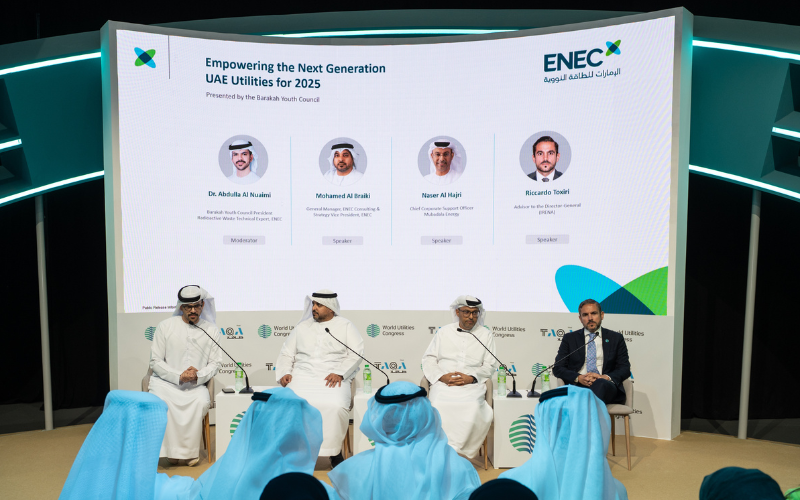
The Innovation theatre will bring together leaders to showcase the sector's critical role in advancing sustainable energy practices and driving decarbonisation efforts, reflecting the full transition journey from system redesign and grid expansion, to flexibility, water resilience, firm power, and climate-ready urban infrastructure.
• Power generation (renewables, hybrid systems, advanced gas turbines)
• Long-duration & grid-scale energy storage (batteries, flow batteries, thermal storage)
• Nuclear (SMRs, advanced nuclear technologies)
• Hydrogen production (green & blue hydrogen) and system integration
• Energy system resilience and flexibility at generation level
• Hydrogen storage, transport & infrastructure
• Ammonia, synthetic fuels & Power-to-X solutions
• Hydrogen for heavy industry, aviation & shipping
• Integration with industrial clusters and export markets
• Carbon capture, utilisation & storage (CCUS)
• Direct air capture (DAC) and carbon removals
• Industrial decarbonisation pathways
• Carbon markets, trading, offsets & nature-based solutions
• Waste-to-energy & industrial symbiosis
• Sludge-to-energy & resource recovery
• Circular water and material flows
• Zero-waste and resource-efficient utility models
• Demand response & flexibility markets
• Process electrification for heavy industry
• Net-zero buildings & carbon standards
• Smart grids, microgrids & DER integration
• Cogeneration & waste heat recovery
• AI for predictive grid and water management
• Digital twins & asset lifecycle optimisation
• Advanced forecasting & system optimisation
• Autonomous operations & edge computing
• Cybersecurity & AI-enabled threat detection
• Prosumers, rooftop solar & energy communities
• Peer-to-peer energy trading & blockchain
• Smart metering (AMI) and customer platforms
• Behavioural insights & demand-side efficiency programmes
• Water reuse & zero-liquid discharge systems
• Desalination innovation & efficiency
• Climate-resilient water systems & infrastructure
• Transboundary water cooperation & resilience policy
• Nature-based water infrastructure
• Co-optimisation of water and power systems
• Energy-efficient water treatment & operations
• Renewable-powered desalination
• Integrated planning across utilities and infrastructure
• EV ecosystems (charging networks, V2G, fleet electrification)
• Advanced battery technologies & recycling
• Hydrogen & e-fuels for transport
• Integrated transport–energy–water systems
• Sustainable urban design & adaptive cooling
• Climate tech investment & scale-up
• Power purchase agreements, PPPs & financing models
• Government-to-government partnerships & alliances
• Energy transition M&A and capital flows
• Regulatory frameworks & incentives for transition
• Critical minerals & supply chain resilience
• Infrastructure security & risk management
• Workforce upskilling & digital transformation
• Talent, leadership & organisational change



dmg events is an international exhibition and conference organiser, publisher and information provider to the Energy, Construction, Plastics, Coatings, Manufacturing, Transport, Design and Hospitality industries.
Member of


